
“Among the plethora of illustrators of varying caliber featured in the exhibition, the one who best captures the meticulous and whimsical genius of Tolkien is undoubtedly Piero Crida; his extraordinary, abstract, ‘ring-themed’ visions—reproduced from the Rusconi edition—prove far more striking than the literal, didactic depictions by contemporary English illustrators.”
Elena Morra / Luca Scarlini – Il Sole 24 Ore
“Piero Crida is among the last exponents in the West of ‘sacred’ art… The colors of the *cauda pavonis*—the peacock’s tail—of the philosopher’s stone, the flavor of *Bodhi*, the orgiastic fusion of *Vijnana* and *Vasana*, the aspiration toward the Goethean *Mehr Licht*—these are the elements that motivate and structure the work of Piero Crida.”
Arturo Schwarz
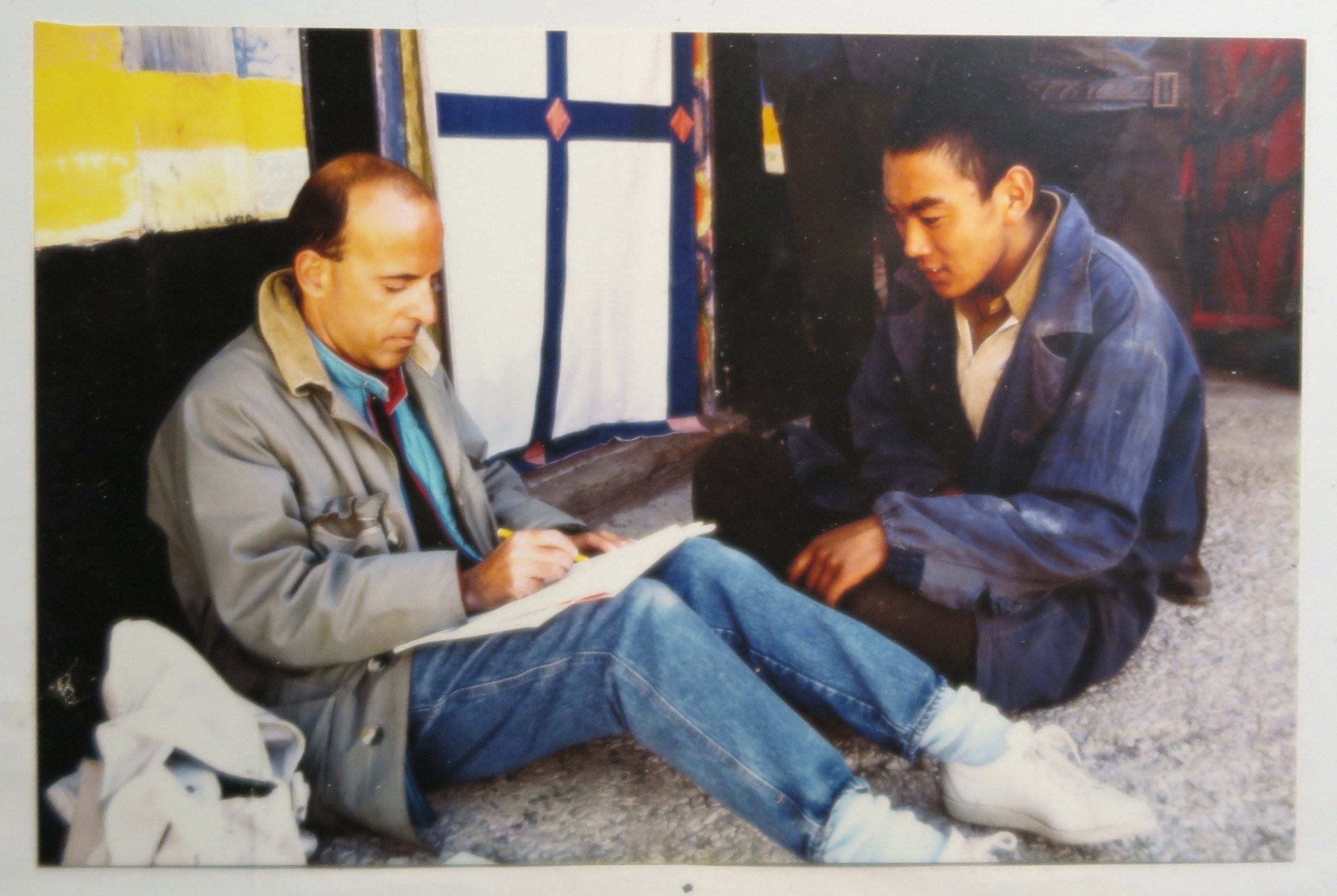
“…he has pushed the quality of watercolor painting to the absolute limits of what is possible. The reality of any pictorial expression lies in its emblematic content; and so, he has stretched the boundaries of what can be articulated to their furthest extreme, arriving at a state of absolute rarefaction—a ‘grasping of God’ (or the soul, spirituality, the essence of Being, the mystery of the life we inhabit)—through watercolors of immeasurable symbolic subtlety. Crida’s work is thus rich and resonant; it speaks to everyone, offering a message for each individual and providing a mirror in which one may recognize oneself. Yet, by the eternal nature of art, Crida himself may never find the stillness required to truly see his own reflection—for his task (his gift, or perhaps his curse) is to remain in an eternal search for the word he must convey to us, burdened all the while by a sublime quality that already consigns him to the difficult, obscure, and timeless realm of Glory.”
Gabriele Mandel
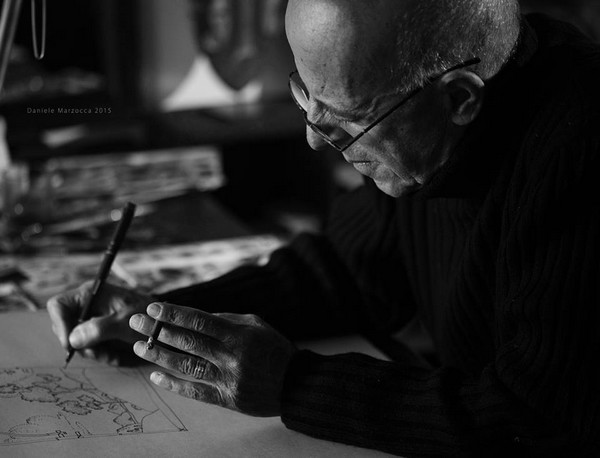
“…Every work produced by Piero Crida is a ritual practice, undertaken to attain that mental calm and state of inner tranquility which allow one to face the vicissitudes of life with the imperturbability of a Bodhisattva. For him, painting is a way of cultivating the path back to the source—what Chinese esotericists call *ju men*, ‘passing through the threshold,’ to arrive in a realm where things unfold of their own accord within an undifferentiated unity composed of a multitude of shifting elements.”
The sheet of paper: that is where the shattered individuality of Piero Crida is pieced back together.
It is there that painting becomes a site of ritual, where everything takes on the appearance of a challenge between the imperfect and perfection. It is there that it carries its own destiny. The calligraphic definition of the subjects points to a rigorous internal analysis—one that cuts into the consciousness with the precision of a laser—while the soft, light hues of a watercolor technique that allows for no errors (even when they darken to fill spaces of stark harshness) reveal a delicate and fragile personality.
The aesthetic purity that strikes those who view his works—evoking immediate emotions—is the result of a journey into the unconscious, where death and rebirth are linked by the persistent pull of an intermediate state reaching toward the light, understood as a wisdom that unifies all things. It is precisely this thirst for light that serves as the common thread uniting all of Piero Crida’s works.
Lama Paljin Tulku Rinpoce

